Wednesday, September 10, 2014

Last of a Line

Well, we've folded the hangar doors open and dusted things off a bit... it's been a while.

For our first post here in a few months, a quickie...

This is the LFG Roland D.XVII... the last single-seat scout fighter constructed by LFG during the Great War. Only one was built and it wasn't much of a success. Even had it been a better performer, it was first 'rolled out' in October of 1918 and so, too little too late...

Project 914 Archives


Fade to Black...


Wednesday, April 9, 2014

Look... it's a bird... no! It's a plane! Uh... it's a plane that came from a plant?

Alrighty, here's one that's fascinated your blogmeister for some time.... the Taube. This crate really does look like a bird, doesn't it? A dove, to be more specific, and that is indeed what the German word 'Taube' means... 'dove'.

National Geographic January 1918 (Brown & Dawson)


Yeah, well, apparently the design was actually inspired by a particularly aerodynamic seed pod of the Zanonia, a monotypic genus in the flowering plant family Cucurbitaceae. (Don't write in asking what the hell any of that means... we've no clue.) Look, let's forget seeds and plants and all that... truth be told, nobody here at Stringbags has a green thumb and we much prefer the bird angle anyway, so we'll fly with it. (See what we did there?)

Anyhoo... this-here plane that looks like a bird even though it was inspired by a plant was designed by an Austro-Hungarian guy named Igo Etrich (we're willing to bet that he had a green thumb) and first flew in 1910. Long story short, the design was licensed out for production to a few manufacturers, including Rumpler of Germany. Rumpler played along with Etrich for a while, labeling their version of the plant bird as the 'Etrich-Rumpler Taube'... but then they apparently got greedy or something and pruned Etrich out entirely, changing the bird's name to 'Rumpler Taube' and stopped paying royalties and such. Etrich gave up, abandoned his patent, stomped off, and went home... probably to do some gardening.


A Rumpler Taube after takeoff from Köln-Longerich, 1913-14.

Bundesarchiv


Still trying to keep a long story short(ish), the Taube was the first mass-produced military aircraft in Germany and filled pretty much every role conceived for military aviation at that time. Ultimately, though, as is the case with many designs, the Taube was relegated to training duties... having served Germany and a few other nations well in the pre-war years, it was found to be quite lacking as a war machine once hostilities erupted in 1914 and more advanced types began sprouting up.

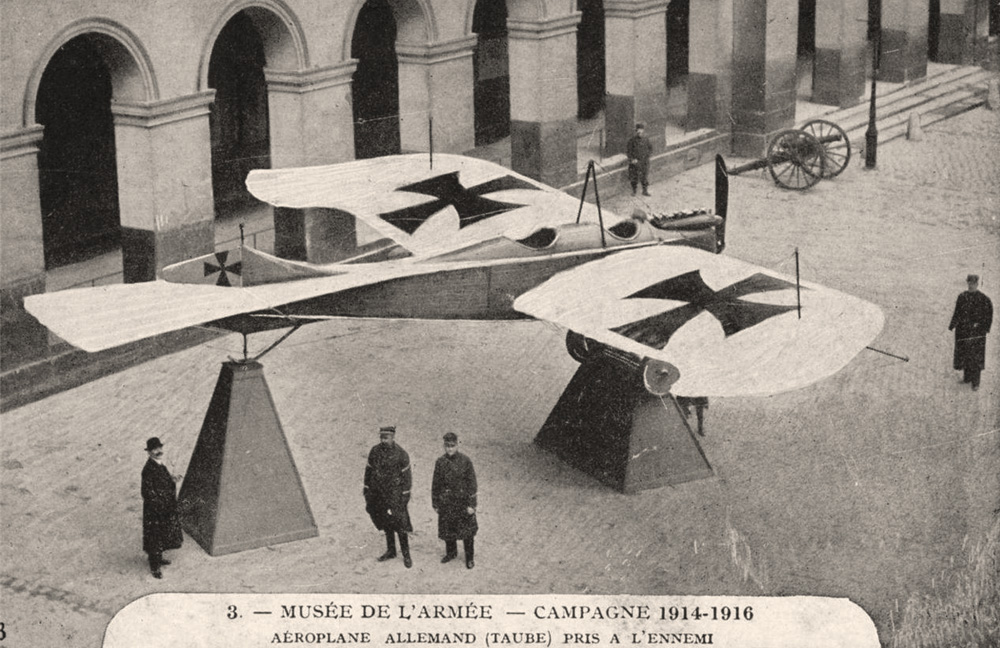
Nevertheless, the Taube did see a good deal of use in combat during the early months of The Great War, primarily as an observation platform. The two photos below show one example that was captured by the French and displayed in the courtyard of the Army Museum at Les Invalides, Paris.

Project 914 Archives

Project 914 Archives


And now to wrap things up, here's a super-freakin' groovy painting of a Taube by Russell Smith. Check out more of his excellent work on his Facebook page...


Okay... that's it for now. Time to make like a tree and get outta here.


Fade to Black...


Saturday, August 31, 2013

The Wayback Machine is Code 2

Well, he's done it now. Your blogmeister has a tendancy to twirl the dial on the Wayback Machine a bit too quick-like, and he's gone'n done-busted the dang thang. Oh, it still works... but it ain't workin' proper-like, if ya take our meanin'. So today we bring you something a tad different than the usual fare.

Sometime back we came across a number of photos from the year nineteen-hundred and fifty-seven, showing two Great War wannabes keeping company with some RF-84s and a single T-33 of the Tennessee Air National Guard. In this installment of 'Stringbags' we present one of those photos.

Your blogmeister has yet to break out the pick and spade, so we can't tell you anything further... for the moment... except maybe to say that these two biplanes look to be replicas of a Fokker D.VII and a Nieuport 28, and that we will share more shots of each in the future...


Project 914 Archives


Fade to Black...

Monday, August 26, 2013

Testpilot im 'Flugboot'


Today at 'Stringbags' we bring you a groovy photo showing German test pilot Wilhelm Eickhoff in a Roland D.VIa at Hannover Langenhagen Flugplatz circa late 1917 or early 1918.

In January of 1918 the Germans held a fly-off competition to select a new scout/fighter aircraft for the Lufstreitkräfte. Though the winner of that competition was the Fokker D.VII, the runner-up, the Roland D.VI, was also ordered into production as insurance against possible problems with the Fokker... and approximately 350 Rolands were constructed. The type was somewhat unique in that the method of construction used to make its fuselage was essentially the same as that used in the construction of certain types of boats.


Here's a link to some photos showing the last surviving example of this interesting type...


Fade to Black...

Wednesday, August 14, 2013

Golden Gift

Today we take another break from our series on the 1st Aero Squadron to bring you this groovy shot of F.E.2b A5478, named 'Gold Coast No.10'. This particular machine was one of 50 built by Boulton & Paul Ltd. and was a 'presentation gift', one of at least ten aeroplanes that were paid for by the people of Great Britain's Gold Coast colony in West Africa.


Project 914 Archives


Fade to Black...

Monday, August 12, 2013

The Deadly Duo

A few posts back we featured a 1st Aero Squadron observer ace named Arthur Easterbrook. Well, as often happens, we just now came across something which would'a come in real handy-like for that previous installment of this-here cyber-rag. Better late than never, we always say.

Anyhoo, the something we came across which would'a come in real handy-like for that previous installment of this-here cyber-rag was another photo of Lt. Easterbrook... and this time the pilot with whom he scored most of his victories, William Erwin, is also shown. For those who didn't see that previous installment, or for those whose memory could use refreshing, Easterbrook and Erwin were credited with five and eight victories, respectively.

Here's the accompanying caption from the original image, which was apparently reproduced from a publication of some sort:

The formidable team of 1/Lt. William Erwin (pilot) and 1/Lt. Arthur Easterbrook (observer) in their Salmson, reportedly after their first mission together on 1 October 1918. This 2A2 is marked with the final version of the 1st Aero Squadron's insignia, which in this case lacks the white halyard. Note the bullet holes from previous missions patched and marked with black crosses, and the large hole—said to have been made by German anti-aircralt fire. The two white lines painted below the observer's cockpit could be used in aligning a camera. (Easterbrook photo. USAFM via George H. Williams)


via Jim Landon (aka 'thegreatlandoni' on flickr)


Fade to Black...

Friday, August 9, 2013

A Salmson and a Handley Page

We've been spoiling you as of late with a bit more tappin' on the keyboard than normal. Also, your blogmeister is feeling typically lazy today. So, a quickie...

Continuing our series on the 1st Aero Squadron, here's a photo showing one of the outfit's Salmsons with a Handley Page O/400 in the background. We've no info as to the where, when, why, or how.


San Diego Air & Space Museum


Fade to Black...