A long while back we ran a series of posts on the 1st Aero Squadron. Today we continue our look at the 1st with a post-war photo showing one of the most interesting types to be flown by the outfit at any point during its existence.
During the First World War, the Fokker D.VII proved to be one of the most formidable aircraft employed by any nation in that conflict. And one of the stipulations of the armistice agreement after the war was that Germany hand over all examples of the type to the allied nations. The USA acquired more than 140 D.VIIs for evaluation, testing, and training by the Army and Navy, with numerous outfits receiving one or more examples.
One of the aforementioned outfits was the 1st Aero Squadron, and today we present a photo showing one of their D.VIIs in flight over Long Island, New York in July of 1924 with First Lieutenant Eugene Barksdale behind the stick.
Tuesday, June 18, 2024
A Fokker for the First
Library of Congress
Friday, December 30, 2022
Pincher and the Camel
Today we present a fine photo showing 'Pincher', resident mouser aboard the Royal Navy seaplane carrier HMS Vindex, perched atop the propeller hub of a Sopwith Camel during the Great War.
Enjoy...
Imperial War Museum
Fade to Black...
Monday, August 29, 2016
Aufgegeben Gotha
Today we bring you a photo showing the last variant of the famous heavy bomber series produced by Gothaer Waggonfabrik AG during the Great War... the Gotha G.Vb.
Once the war had come to an end, a stipulation of the resulting Armistice was that Germany hand over a large number of aircraft to the Allies... about 1700 or so. Among those specified to be surrendered was the Gotha G.V, and apparently a number of the final G.Vbs to come off the assembly line were delivered to the Allies direct from the factory. It is thought that the aircraft shown here is one of these.
Fade to Black...
Once the war had come to an end, a stipulation of the resulting Armistice was that Germany hand over a large number of aircraft to the Allies... about 1700 or so. Among those specified to be surrendered was the Gotha G.V, and apparently a number of the final G.Vbs to come off the assembly line were delivered to the Allies direct from the factory. It is thought that the aircraft shown here is one of these.
Fade to Black...
Sunday, August 21, 2016
An Aerdrome in Northern France
Alrighty folks, as stated in the past... your blogmeister loves these crates from the 'Great War', but knows relatively little about them as compared to aircraft from other periods in time. All he knows about this photo is that it is said to have been taken in Northern France during the Spring of 1918 and that it shows three Fokkers D.VII, at least two, possibly three Fokkers Dr.1, and a single Albatros, which looks to be a D.V., maybe.
Anyhoo, the only other thing your blogmeister knows about this photo is that it is dang groovy... enjoy!
A couple'a closer crops...
Fade to Black...
Anyhoo, the only other thing your blogmeister knows about this photo is that it is dang groovy... enjoy!
Posted by 'Synonymes' on Flickr
A couple'a closer crops...
Fade to Black...
Tuesday, July 19, 2016
Flying Razor From Down Under
Generally we like to present original period photos in this-here cyber rag, but every now and again we come across modern-day stuff that is too groovy not to share.
Here's a few snaps of The Australian Vintage Aviation Society's Fokker D.VIII replica, powered by an original Gnome rotary engine, which flew for the first time earlier this year.
Fade to Black...
Here's a few snaps of The Australian Vintage Aviation Society's Fokker D.VIII replica, powered by an original Gnome rotary engine, which flew for the first time earlier this year.
Dave White photo
Dave White photo
Dave White photo
Dave White photo
Dave White photo
Fade to Black...
Wednesday, July 6, 2016
Canadian Fokker
For today's quickie we present this view showing Fokker D.VII 8493/18, one of about twenty of the type to be operated briefly by No.1 Fighter Squadron of the Canadian Air Force during early 1919.
For much more info and several more photos showing Canada's Fokker D.VIIs, take a looksee HERE.
Fade to Black...
Project 914 Archives
For much more info and several more photos showing Canada's Fokker D.VIIs, take a looksee HERE.
Fade to Black...
Thursday, June 30, 2016
A Jenny at Langley
In our last installment we shared a few photos showing a Nieuport 17 that was under evaluation at Langley Field during June of 1917. As stated in that previous ish of our little cyber-rag, many a foreign type was given a look by a U.S. Army that had recently been committed to the fight, was pitifully unprepared as regards things aviation, and intent on catching up to the European powers in this area.
Aside from all the foreign types that were put through their paces, a number of domestic designs could also be found at Langley in the Summer of '17... including the ubiquitous Curtiss JN-4 Jenny. And here's a couple'a shots of one such machine. In the first view the aircraft is fitted with an experimental 'Olmstead Propeller', while in the second view it has a standard prop.
Fade to Black...
Aside from all the foreign types that were put through their paces, a number of domestic designs could also be found at Langley in the Summer of '17... including the ubiquitous Curtiss JN-4 Jenny. And here's a couple'a shots of one such machine. In the first view the aircraft is fitted with an experimental 'Olmstead Propeller', while in the second view it has a standard prop.
Library of Congress
Library of Congress
Fade to Black...
Sunday, June 26, 2016
A Nieuport at Langley
Shortly after entering the First World War in April of 1917, the U.S.A., woefully unprepared for war in the air, had to play a game of catch-up and began evaluating foreign aircraft to produce under license at home and for use 'over there'.
Among the many types evaluated was the Nieuport 17. The following photos show Lt. Emmanuel Lemaitre of the Aéronautique Militaire, one of twelve French airmen sent to the U.S.A. in June of 1917 as instructors, looking over Nieuport #2474 with Capt. J.C. Bartolf of the U.S. Army Signal Corps' 5th Aviation School Squadron at Langley Field in Virginia.
Fade to Black...
Among the many types evaluated was the Nieuport 17. The following photos show Lt. Emmanuel Lemaitre of the Aéronautique Militaire, one of twelve French airmen sent to the U.S.A. in June of 1917 as instructors, looking over Nieuport #2474 with Capt. J.C. Bartolf of the U.S. Army Signal Corps' 5th Aviation School Squadron at Langley Field in Virginia.
Library of Congress
Library of Congress
Library of Congress
Fade to Black...
Wednesday, June 22, 2016
The Gang's All Here!
For our first post here in a while, we present a quickie...
The IWM caption for this photo reads:
"Officers and S.E.5a Scouts of No. 1 Squadron, RAF, at Clairmarais aerdrome, 3 July 1918."
Fade to Black...
The IWM caption for this photo reads:
"Officers and S.E.5a Scouts of No. 1 Squadron, RAF, at Clairmarais aerdrome, 3 July 1918."
Project 914 Archives
Fade to Black...
Monday, October 26, 2015
Brünhilde mit Bomben für Tommy
In this installment of Stringbags we present a couple'a photos from May of 1918 which show a Halberstadt CL.II of Royal Bavarian Schlachtstaffel 27b just prior to a sortie during the Ludendorff Offensive.
In the first photo an armorer is seen loading potato mashers into a rack for use by the observer. Affixed to the spine of the kite, just behind the cockpit, is an assortment of flare cartridges.
In this second shot the crew is mounted up and ready for engine start. The inscription on this postcard reads, roughly:
"Schlachststaffel Ready for Takeoff - The aircraft are equipped with machine guns, signal cartridges, and hand grenades."
In the background is another Halberstadt, #5, named 'Thea'. This machine was captured by New Zealand forces after being forced down near Bapaume in late August of 1918.
Fade to Black...
In the first photo an armorer is seen loading potato mashers into a rack for use by the observer. Affixed to the spine of the kite, just behind the cockpit, is an assortment of flare cartridges.
Project 914 Archives
In this second shot the crew is mounted up and ready for engine start. The inscription on this postcard reads, roughly:
"Schlachststaffel Ready for Takeoff - The aircraft are equipped with machine guns, signal cartridges, and hand grenades."
In the background is another Halberstadt, #5, named 'Thea'. This machine was captured by New Zealand forces after being forced down near Bapaume in late August of 1918.
Fade to Black...
Thursday, September 17, 2015
Balancing Act
We have no information to share about this incident... except maybe that the driver of this Camel has undoubtedly seen much better days.
Fade to Black...
Project 914 Archives
Fade to Black...
Tuesday, February 3, 2015
Luft-Luft-Foto
Today we bring you a groovy air-to-air photo of one Leutnant Otto Kissenberth of FFA 9b (FFA = Feld-Flieger Abteilung) cruising over Colmar in his Fokker D.II, circa 1915.
Kissenberth went on to command Jasta 23 and score a total of twenty victories, the last of which was gained on May 20th, 1918 while flying a captured Sopwith Camel! Nine days later he was severely injured in a crash of this same Camel and his combat career came to an end. Kissenberth, an avid mountain-climber, (evidenced by the 'Edelweiss' emblem that normally adorned his personal aircraft) died in August of 1919 after a fall while indulging in his favorite pastime.
Fade to Black...
Kissenberth went on to command Jasta 23 and score a total of twenty victories, the last of which was gained on May 20th, 1918 while flying a captured Sopwith Camel! Nine days later he was severely injured in a crash of this same Camel and his combat career came to an end. Kissenberth, an avid mountain-climber, (evidenced by the 'Edelweiss' emblem that normally adorned his personal aircraft) died in August of 1919 after a fall while indulging in his favorite pastime.
Project 914 Archives
Fade to Black...
Monday, February 2, 2015
Totenkopf
In this installment of 'Stringbags' we present a photo showing a Siemens-Shuckert D.III in Swiss markings and adorned with a Totenkopf (skull and crossbones or, more literally, 'death's head') motif.
Your blogmeister has done only minimal digging on this one, but it seems that this particular bird, along with a few others, was deliberately flown to Switzerland in November of 1918, possibly by a German pilot named Lange of Kest 5, in order to prevent the machine from falling into the hands of Allied forces.
Fade to Black...
Your blogmeister has done only minimal digging on this one, but it seems that this particular bird, along with a few others, was deliberately flown to Switzerland in November of 1918, possibly by a German pilot named Lange of Kest 5, in order to prevent the machine from falling into the hands of Allied forces.
Project 914 Archives
Fade to Black...
Sunday, October 5, 2014
Rumplers
Today on Stringbags we bring you a few views of some Rumplers. We think they're all Rumpler C.Is but, as your blogmeister's enthusiasm for these early birds far outstrips his knowledge of same, we have to take the sparse info that accompanied these images at face value.
Whatever the case, they're pretty cool photos... enjoy.
Fade to Black...
Whatever the case, they're pretty cool photos... enjoy.
Project 914 Archives
San Diego Air & Space Museum
Fade to Black...
Thursday, September 11, 2014
Back to the 1st...
Alrighty... a while back we had a series going that focused on the ASAEF 1st Aero Squadron, but took a short break from said series and posted a few random things before your blogmeister took a general break from 'Stringbags' altogether.
Today we resume our series on the 1st Aero Squadron with a few photos from the Arthur J. Coyle collection within the San Diego Air & Space Museum archives. Some of you may recognize the name 'Arthur Coyle', as he was mentioned in one of our earlier installments... Coyle, who was credited with three victories, was piloting the crate named 'Gertrude A' when gunner Arthur Easterbrook scored his fifth victory on November 4th, 1918. (Take a looksee HERE.)
Anyhoo, as mentioned, here's a few random photos from the Coyle collection. We have no further info for any of them at this time, other than to say that the third shot shows not a Salmson of the 1st AS, but rather a British SE.5.
Enjoy...
More 1st Aero Squadron stuff to come!
Fade to Black...
Today we resume our series on the 1st Aero Squadron with a few photos from the Arthur J. Coyle collection within the San Diego Air & Space Museum archives. Some of you may recognize the name 'Arthur Coyle', as he was mentioned in one of our earlier installments... Coyle, who was credited with three victories, was piloting the crate named 'Gertrude A' when gunner Arthur Easterbrook scored his fifth victory on November 4th, 1918. (Take a looksee HERE.)
Anyhoo, as mentioned, here's a few random photos from the Coyle collection. We have no further info for any of them at this time, other than to say that the third shot shows not a Salmson of the 1st AS, but rather a British SE.5.
Enjoy...
All photos: Arthur J. Coyle collection - San Diego Air & Space Museum
More 1st Aero Squadron stuff to come!
Fade to Black...
Wednesday, September 10, 2014
Last of a Line
Well, we've folded the hangar doors open and dusted things off a bit... it's been a while.
For our first post here in a few months, a quickie...
This is the LFG Roland D.XVII... the last single-seat scout fighter constructed by LFG during the Great War. Only one was built and it wasn't much of a success. Even had it been a better performer, it was first 'rolled out' in October of 1918 and so, too little too late...
Fade to Black...
For our first post here in a few months, a quickie...
This is the LFG Roland D.XVII... the last single-seat scout fighter constructed by LFG during the Great War. Only one was built and it wasn't much of a success. Even had it been a better performer, it was first 'rolled out' in October of 1918 and so, too little too late...
Project 914 Archives
Fade to Black...
Wednesday, April 9, 2014
Look... it's a bird... no! It's a plane! Uh... it's a plane that came from a plant?
Alrighty, here's one that's fascinated your blogmeister for some time.... the Taube. This crate really does look like a bird, doesn't it? A dove, to be more specific, and that is indeed what the German word 'Taube' means... 'dove'.
Yeah, well, apparently the design was actually inspired by a particularly aerodynamic seed pod of the Zanonia, a monotypic genus in the flowering plant family Cucurbitaceae. (Don't write in asking what the hell any of that means... we've no clue.) Look, let's forget seeds and plants and all that... truth be told, nobody here at Stringbags has a green thumb and we much prefer the bird angle anyway, so we'll fly with it. (See what we did there?)
Anyhoo... this-here plane that looks like a bird even though it was inspired by a plant was designed by an Austro-Hungarian guy named Igo Etrich (we're willing to bet that he had a green thumb) and first flew in 1910. Long story short, the design was licensed out for production to a few manufacturers, including Rumpler of Germany. Rumpler played along with Etrich for a while, labeling their version of theplant bird as the 'Etrich-Rumpler Taube'... but then they apparently got greedy or something and pruned Etrich out entirely, changing the bird's name to 'Rumpler Taube' and stopped paying royalties and such. Etrich gave up, abandoned his patent, stomped off, and went home... probably to do some gardening.
A Rumpler Taube after takeoff from Köln-Longerich, 1913-14.
Still trying to keep a long story short(ish), the Taube was the first mass-produced military aircraft in Germany and filled pretty much every role conceived for military aviation at that time. Ultimately, though, as is the case with many designs, the Taube was relegated to training duties... having served Germany and a few other nations well in the pre-war years, it was found to be quite lacking as a war machine once hostilities erupted in 1914 and more advanced types began sprouting up.
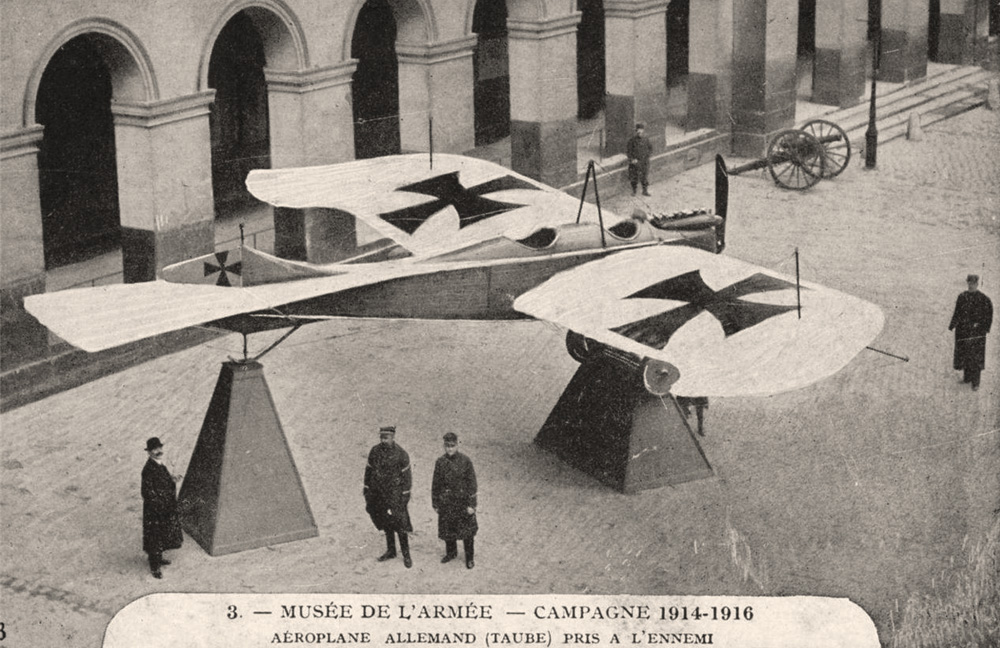
Nevertheless, the Taube did see a good deal of use in combat during the early months of The Great War, primarily as an observation platform. The two photos below show one example that was captured by the French and displayed in the courtyard of the Army Museum at Les Invalides, Paris.
And now to wrap things up, here's a super-freakin' groovy painting of a Taube by Russell Smith. Check out more of his excellent work on his Facebook page...
Okay... that's it for now. Time to make like a tree and get outta here.
Fade to Black...
National Geographic January 1918 (Brown & Dawson)
Yeah, well, apparently the design was actually inspired by a particularly aerodynamic seed pod of the Zanonia, a monotypic genus in the flowering plant family Cucurbitaceae. (Don't write in asking what the hell any of that means... we've no clue.) Look, let's forget seeds and plants and all that... truth be told, nobody here at Stringbags has a green thumb and we much prefer the bird angle anyway, so we'll fly with it. (See what we did there?)
Anyhoo... this-here plane that looks like a bird even though it was inspired by a plant was designed by an Austro-Hungarian guy named Igo Etrich (we're willing to bet that he had a green thumb) and first flew in 1910. Long story short, the design was licensed out for production to a few manufacturers, including Rumpler of Germany. Rumpler played along with Etrich for a while, labeling their version of the
A Rumpler Taube after takeoff from Köln-Longerich, 1913-14.
Bundesarchiv
Still trying to keep a long story short(ish), the Taube was the first mass-produced military aircraft in Germany and filled pretty much every role conceived for military aviation at that time. Ultimately, though, as is the case with many designs, the Taube was relegated to training duties... having served Germany and a few other nations well in the pre-war years, it was found to be quite lacking as a war machine once hostilities erupted in 1914 and more advanced types began sprouting up.
Nevertheless, the Taube did see a good deal of use in combat during the early months of The Great War, primarily as an observation platform. The two photos below show one example that was captured by the French and displayed in the courtyard of the Army Museum at Les Invalides, Paris.
Project 914 Archives
And now to wrap things up, here's a super-freakin' groovy painting of a Taube by Russell Smith. Check out more of his excellent work on his Facebook page...
Okay... that's it for now. Time to make like a tree and get outta here.
Fade to Black...
Saturday, August 31, 2013
The Wayback Machine is Code 2
Well, he's done it now. Your blogmeister has a tendancy to twirl the dial on the Wayback Machine a bit too quick-like, and he's gone'n done-busted the dang thang. Oh, it still works... but it ain't workin' proper-like, if ya take our meanin'. So today we bring you something a tad different than the usual fare.
Sometime back we came across a number of photos from the year nineteen-hundred and fifty-seven, showing two Great War wannabes keeping company with some RF-84s and a single T-33 of the Tennessee Air National Guard. In this installment of 'Stringbags' we present one of those photos.
Your blogmeister has yet to break out the pick and spade, so we can't tell you anything further... for the moment... except maybe to say that these two biplanes look to be replicas of a Fokker D.VII and a Nieuport 28, and that we will share more shots of each in the future...
Fade to Black...
Sometime back we came across a number of photos from the year nineteen-hundred and fifty-seven, showing two Great War wannabes keeping company with some RF-84s and a single T-33 of the Tennessee Air National Guard. In this installment of 'Stringbags' we present one of those photos.
Your blogmeister has yet to break out the pick and spade, so we can't tell you anything further... for the moment... except maybe to say that these two biplanes look to be replicas of a Fokker D.VII and a Nieuport 28, and that we will share more shots of each in the future...
Project 914 Archives
Fade to Black...
Monday, August 26, 2013
Testpilot im 'Flugboot'
Today at 'Stringbags' we bring you a groovy photo showing German test pilot Wilhelm Eickhoff in a Roland D.VIa at Hannover Langenhagen Flugplatz circa late 1917 or early 1918.
In January of 1918 the Germans held a fly-off competition to select a new scout/fighter aircraft for the Lufstreitkräfte. Though the winner of that competition was the Fokker D.VII, the runner-up, the Roland D.VI, was also ordered into production as insurance against possible problems with the Fokker... and approximately 350 Rolands were constructed. The type was somewhat unique in that the method of construction used to make its fuselage was essentially the same as that used in the construction of certain types of boats.
Here's a link to some photos showing the last surviving example of this interesting type...
Fade to Black...
Wednesday, August 14, 2013
Golden Gift
Today we take another break from our series on the 1st Aero Squadron to bring you this groovy shot of F.E.2b A5478, named 'Gold Coast No.10'. This particular machine was one of 50 built by Boulton & Paul Ltd. and was a 'presentation gift', one of at least ten aeroplanes that were paid for by the people of Great Britain's Gold Coast colony in West Africa.
Fade to Black...
Project 914 Archives
Fade to Black...
Subscribe to:
Posts (Atom)